
Rockwool Home Energy Audit in Burbank: What to Know First
A Rockwool home energy audit in Burbank is a whole-house diagnostic that measures exactly where your home leaks air, how well your stone wool insulation is performing, and what it will take to stop the energy bleed. We’re an independent Rockwool service provider - not a manufacturer rep - so our findings are based on what we actually see in your attic, walls, and ductwork, not on a sales script. Most audits take two to three hours on site, and the report you get is plain-English, with photos and a prioritized fix list. If you’re in Burbank and your energy bills keep climbing while your Rockwool is supposed to be doing its job, call (747) 837-5834 and talk to a live person today. This page is for Burbank homeowners who already have Rockwool insulation and want to know if it’s still working, or who suspect it was never installed correctly in the first place.
How Rockwool Products Fail - and How We Fix Them
Rockwool stone wool is genuinely tough stuff. It won’t sag like fiberglass batts, it’s fire-resistant, and it holds its R-value over time. But even the best insulation doesn’t work if the house around it leaks air, and we find certain failure patterns in Burbank homes that come up again and again. Here’s what we see with Rockwool specifically:
- Compressed batts in sloped Burbank attics. Rockwool Comfortbatt comes in pre-cut lengths sized for standard framing. In older Burbank homes near Magnolia Park and the hillside streets above Glenoaks, we regularly find rafters spaced wider or narrower than modern spec. Installers force the batts in, compressing the edges, and that compression drops the effective R-value faster than most homeowners realize. We measure actual installed depth and density with a thermal imaging pass, then restore or replace the affected sections.
- Air bypass around Rockwool Safe’n’Sound in interior walls. Safe’n’Sound is built for acoustic control, not thermal performance. It’s a great product, but some contractors use it in exterior walls to save a trip to the yard, and it does almost nothing to stop heat transfer. In Burbank, where summer attic temperatures run into the 130s, that mistake shows up as hot bedroom walls every August. Our blower door test identifies where the real thermal barrier is missing, and we replace the wrong product with Rockwool Comfortbatt R-15 or R-23, depending on the cavity depth.
- Gaps where Rockwool batts meet awkward framing. Stone wool cuts cleanly with a serrated blade, but around plumbing vents, electrical boxes, and irregular corners, even careful installers leave small voids. These gaps are invisible until we run a blower door test and see the smoke trail. We’ve found gaps in almost every home we audit in Burbank that wasn’t built to current Title 24 air-sealing standards. Air sealing those gaps, then re-dressing the Rockwool, often cuts the measured leakage by 20 to 30 percent on its own.
- Moisture trapped against Rockwool in crawl space ceilings. Rockwool is vapor-permeable by design, which is usually a good thing. But in a Burbank crawl space with high humidity and no vapor barrier, that permeability lets moisture move through the insulation and condense against the subfloor. We see this frequently in older homes near the Verdugo Wash corridor. The fix is not more insulation; it’s fixing the moisture path first - installing or repairing the vapor barrier under the house - and then addressing the insulation above.
- Settled or disturbed loose Rockwool in attics. Rockwool loose-fill is denser than cellulose and tends to hold its loft, but after a rodent problem, a plumbing repair, or a contractor tramping through the attic, the distribution gets uneven. The R-value varies from spot to spot, and most of it follows the path of the disturbance instead of staying uniform. Our audit includes a grid-pattern depth check so you see exactly where the coverage is thin, not just how the average looks.
Our Rockwool Home Energy Audit Process
We’ve refined this process over years of crawling through Burbank attics and crawl spaces, and we keep it straightforward. You always know what’s happening, why it matters, and what it costs before we touch anything.
- 1
Call and talk to a person. When you call (747) 837-5834, a live person answers - day or night. We ask a few quick questions about your home, your Rockwool, and the symptoms you’re noticing, then schedule the audit at a time that works for you.
- 2
Visual inspection of all accessible Rockwool. We start in the attic and work through the house, checking insulation depth, density, and distribution. We photograph what we find so you see it too, even the things behind a hatch door you’d never open yourself.
- 3
Blower door test. A calibrated fan mounts into an exterior door frame and depressurizes the house. The manometer reads the total air leakage in CFM. For Burbank homes, the number is almost always higher than the owner expected. This is the single most useful number in the entire audit.
- 4
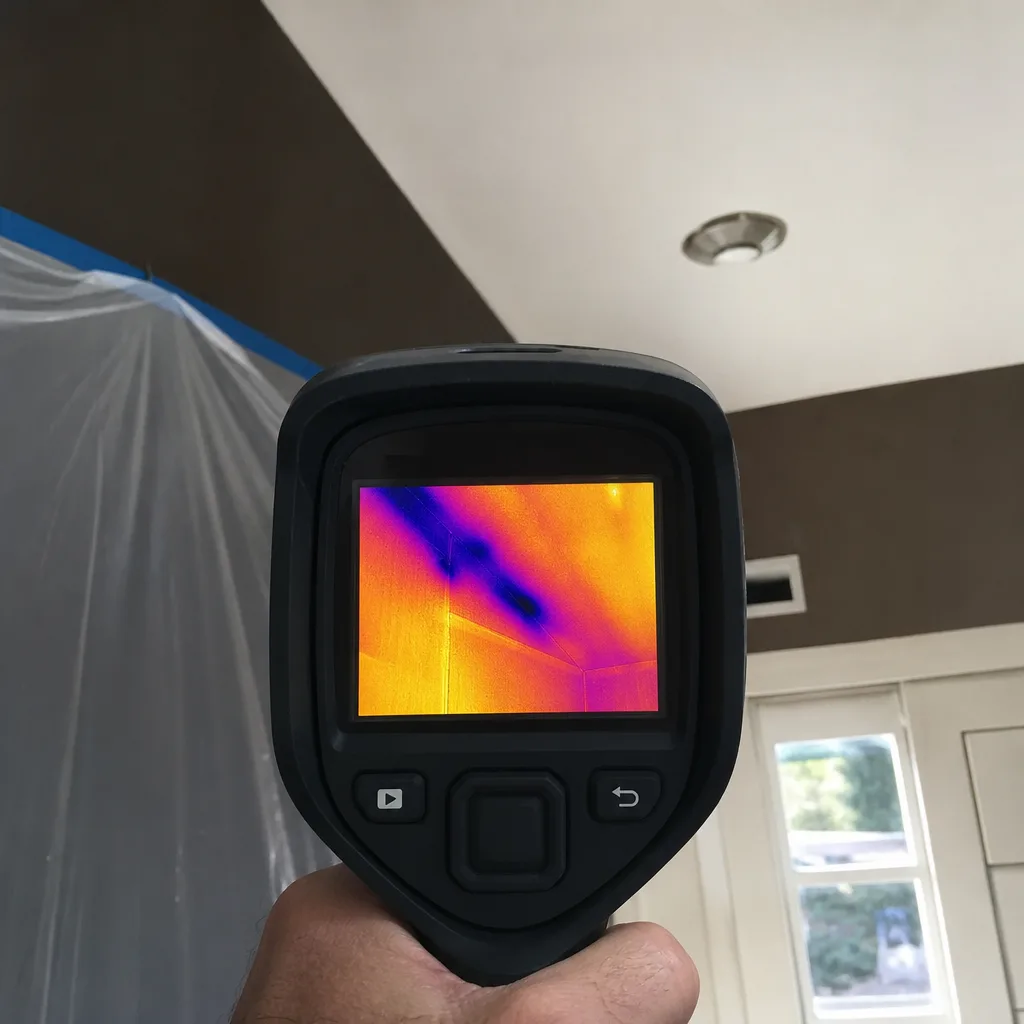
Thermal imaging sweep. With the house depressurized, outside air gets pulled through every gap, showing up as clear temperature anomalies on infrared. We map the thermal bridges, the missing Rockwool sections, and the air paths around can lights, chimneys, and top plates. You get a marked-up set of images in your report.
- 5
Duct leakage test where needed. If your ducts run through the attic or crawl space, we pressurize the system and measure how much conditioned air is escaping before it ever reaches a vent. In Burbank, most duct systems leak 15 to 25 percent, and this is where a lot of Rockwool homeowners are losing money despite having good insulation.
- 6
Report, priority list, and price. Before we leave, Neil walks you through the findings and what we recommend, in that order. No pressure, no mystery pricing. If you want us to fix what we found, most jobs are completed in a single follow-up visit, and everything we do carries the 90-Day Done Right Promise.
What Rockwool Home Energy Audit Costs in Burbank
In Burbank, a Rockwool home energy audit from a capable independent contractor typically runs between $250 and $600, depending on the size of the house and how many diagnostic tests are included. A blower door test alone is usually $150 to $250, while a full audit with thermal imaging and duct leakage testing lands closer to the $400 to $600 range for a typical 1,500 to 2,200 square foot home. Larger homes, multiple HVAC systems, or difficult access (tight attics, low crawl spaces) push the price toward the upper end. If we perform any repair work after the audit - air sealing, insulation replacement, vapor barrier work - the audit findings feed directly into the work scope, so you’re not paying for guesswork. Call (747) 837-5834 for an exact quote. Estimates are free, and the price we quote is the price you pay.
Why Burbank Homeowners Call Warmline Insulation Co. for Rockwool Work
Neil Ashford started this company in 2011 after spending years learning building science at Los Angeles Trade-Technical College and in the field, and he built Warmline around a simple idea: diagnose first, then fix, and stand behind the work. We’re one of the few Burbank-area teams that handles all ten service categories under one roof - attic insulation, spray foam, blown-in, radiant barrier, crawl space encapsulation, air sealing, wall insulation, removal and replacement, attic cleaning and rodent proofing, and home energy audits - so you’re not coordinating three different subcontractors for one problem. We work with Rockwool as an independent service provider, and we also work with Reflectix and the full range of Owens Corning, CertainTeed, Icynene, Demilec, Johns Manville, Knauf, and GreenFiber products, which means our recommendation is based on what’s right for your house, not what’s on our truck. Every technician is background-checked and uniformed. The 90-Day Done Right Promise is in writing: if the work isn’t right, we make it right. And when you call, a live person answers - 24/7, no voicemail maze. Most jobs are completed in a single visit.
FAQs
Rockwool products generally carry a limited lifetime warranty for residential applications, but the warranty covers manufacturing defects in the product itself - not installation errors, compression, air gaps, or the performance of the house around it. As an independent Rockwool service provider, we can help you document what’s in your attic and determine whether a warranty claim is worth pursuing, but most of the problems we find in Burbank homes are installation or air-sealing issues, which are not warranty items. Call (747) 837-5834 and we’ll look at it honestly, with no charge for the assessment if we’re already on site for an audit.
In many cases, yes. If the issues are limited to air sealing, small gaps in the Rockwool, or a section of compressed batt, our techs can often handle the repair in the same visit as the audit. Larger jobs - re-insulating an entire attic, crawl space vapor barrier work, or duct sealing - typically require a follow-up visit. Most jobs at Warmline are completed in a single visit, and we’ll tell you upfront which category yours falls into. Call (747) 837-5834 to schedule.
A full attic Rockwool replacement in Burbank usually runs from $1,800 to $4,200 for a typical home, depending on the square footage, the existing Rockwool that needs removing, and whether air sealing is included. You can also use our $50 Off Any Repair Over $250 offer to reduce the cost, and the 5% Senior & Veteran discount stacks with it. Get an exact number by calling (747) 837-5834 - the quote is free and upfront.
A blower door test finds the air leaks that your Rockwool was never designed to stop. Insulation slows heat transfer through materials. It does almost nothing for air movement through gaps. If your Rockwool is in place but your Burbank home still feels drafty in winter and hot upstairs in summer, air leakage is the likely culprit, and the blower door is the only way to measure it accurately. We’ve audited homes with excellent Rockwool coverage that were leaking 30 percent of their conditioned air through unsealed top plates, can lights, and attic hatches. The test is the difference between guessing and knowing. Call (747) 837-5834 and we’ll walk you through what’s involved.
Rockwool stone wool holds its shape and R-value longer than fiberglass, resists fire, and blocks sound unusually well. Its main weakness in Burbank is that no batt, however good, performs if the air barrier is missing. We recommend Rockwool for many Burbank homes because of its thermal stability in hot attic conditions, but we always pair it with real air sealing. Good insulation shouldn’t be something you think about - that means it’s working. When you’re ready to find out whether yours is doing its job, call (747) 837-5834.
Written by Neil Ashford, Owner, Warmline Insulation Co. at Warmline Insulation Co., serving Burbank and nearby areas.