
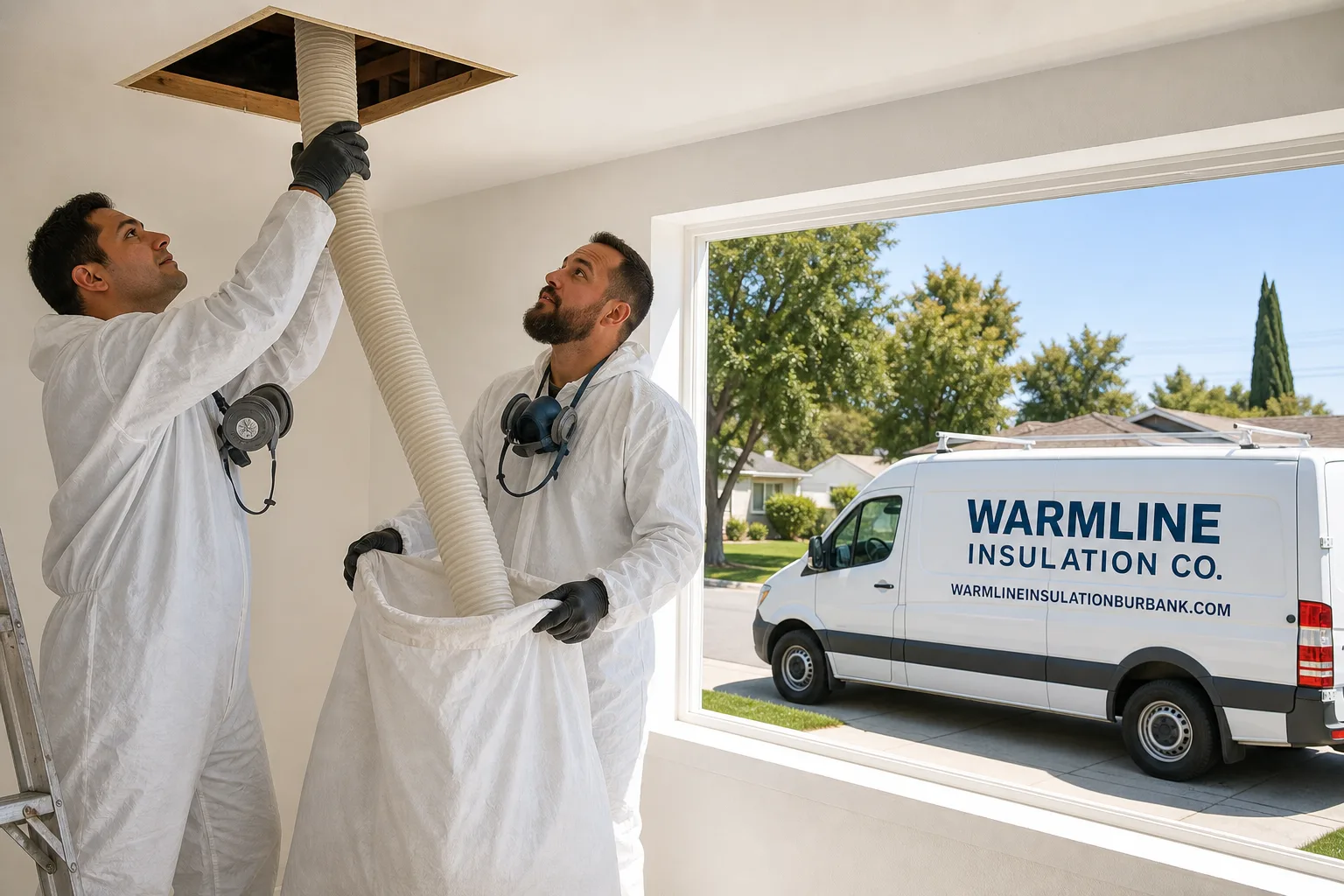
How Much Does Attic Insulation Cost in Burbank?
Our Attic Insulation Near Me in Burbank, CA typically costs between $1,400 and $3,800 for a standard single-family home, with most homeowners landing around $2,200 for a full blown-in or batt installation. Jobs that include old insulation removal, air sealing, or attic cleaning will push toward the higher end of that range. Most projects are completed in a single visit, and free estimates are available by calling (747) 837-5834.
If you want to skip straight to booking, our Attic Insulation in Burbank service page covers what we do and how the process works from start to finish.
Attic Insulation Cost Breakdown (2026)
Prices below reflect the Burbank market as of 2026. Your final number depends on attic size, current insulation condition, and the type of material chosen. These are real ranges pulled from jobs we complete in Burbank and the surrounding San Fernando Valley communities – not national averages recycled from a contractor aggregator.
| Service / Material | Typical Cost Range (Burbank, 2026) | Notes |
|---|---|---|
| Blown-In Fiberglass (per sq ft, installed) | $1.20 – $2.10 | Most common upgrade in Burbank’s older ranch homes |
| Blown-In Cellulose (per sq ft, installed) | $1.10 – $1.90 | Good thermal and acoustic performance; eco-friendly option |
| Fiberglass Batts (per sq ft, installed) | $0.90 – $1.70 | Works best in accessible, standard-joist attics |
| Spray Foam (open-cell, per sq ft) | $1.80 – $3.20 | Ideal for air sealing while insulating; Icynene and Demilec products |
| Spray Foam (closed-cell, per sq ft) | $3.00 – $5.50 | Maximum R-value per inch; best for tight or low-pitch attics |
| Radiant Barrier (foil, installed) | $0.80 – $1.50 | Particularly effective in Burbank given 280+ sunny days per year |
| Old Insulation Removal (full attic) | $600 – $1,400 | Required when pest contamination, moisture damage, or vermiculite is present |
| Attic Air Sealing (standalone) | $350 – $900 | Often bundled with insulation install; addresses bypass leaks at top plates |
| Attic Cleaning and Rodent Proofing | $450 – $1,200 | Common in Burbank’s hillside neighborhoods like Wildwood Canyon and Rancho |
| Full Attic Project (average 1,200-1,800 sq ft home) | $1,400 – $3,800 | Includes removal (if needed), air sealing, and new insulation |
What Pushes the Price Up or Down
The single biggest variable in Burbank is attic access. Many of the mid-century homes in Magnolia Park and the Rancho district have low-clearance attics with tight knee walls, which adds labor time compared to a flat, open attic over a newer build. Homes near the Verdugo Mountains with steep roof pitches face the same challenge.
Material choice is the second lever. Blown-in fiberglass from Owens Corning or Knauf runs less per square foot than closed-cell spray foam from Icynene, but the right choice depends on your attic’s geometry and your comfort goals – not just your budget. We walk you through that decision during your free estimate so you’re not paying for a product that’s overkill or undershooting your needs.
Finally, project scope matters. A home that just needs a top-up of existing insulation costs far less than one where old, rodent-contaminated batts need to come out before anything new goes in. In our experience serving Burbank since 2011, roughly 40% of homes we visit need at least partial removal before new insulation can do its job properly.
What Affects Attic Insulation Pricing in Burbank
- Attic size and layout. Larger attics cost more in material and labor. Attics with multiple HVAC units, ductwork running through the space, or poor interior access (common in Burbank’s 1950s and 1960s stock) take longer to insulate correctly, which shows up in the quote.
- Existing insulation condition. If what’s already up there is degraded, compressed, pest-damaged, or contaminated with rodent droppings – a situation we see regularly in Burbank’s hillside neighborhoods – it needs to come out first. Removal adds $600 to $1,400 to the project but is not optional when the old material is acting as a harbor for bacteria or pests.
- Insulation type and R-value target. California’s Title 24 energy code requires R-38 in climate zone 9, which covers Burbank. Getting from, say, R-11 (what many 1970s homes still have) up to R-38 or beyond requires more material than a simple top-up. The higher the starting gap, the more it costs to close it – but also the more you save on your monthly SoCal Gas and LADWP bills.
- Air sealing scope. Insulation alone doesn’t stop air movement through top-plate penetrations, recessed light cutouts, or HVAC boot gaps. Burbank homes with open-cell construction often have significant bypass leakage, and sealing those points before adding insulation can dramatically improve performance. We include air sealing assessments in every estimate because skipping it is the most common reason homeowners don’t feel the results they expected.
- Burbank’s climate context. At roughly 1,050 feet elevation in the eastern San Fernando Valley, Burbank bakes in summer – regularly hitting 100°F or above during August heat events – and sees cool, damp winters that create condensation risk in attics with inadequate ventilation. That climate profile means radiant barriers paired with blown-in insulation often deliver better real-world savings here than in coastal markets where summer heat is less intense. That combination adds modest cost upfront but accelerates the payback period.
- Rodent activity and attic cleaning needs. Burbank’s proximity to the Verdugo Hills means roof rat pressure is real, especially in the Rancho, Wildwood Canyon, and Olive Avenue corridor neighborhoods. When rodents have nested in existing insulation, the contaminated material has to come out, the attic has to be sanitized, and entry points must be sealed before new insulation goes in. Skipping any of those steps just insulates around the problem.
How to Save on Attic Insulation in Burbank
Stack Utility Rebates with Your Project
LADWP and SoCal Gas both offer rebates for attic insulation upgrades that bring your home to or above Title 24 standards. The exact amounts shift year to year and depend on the R-value improvement achieved, but rebates in the range of $150 to $400 are typical for a qualifying Burbank home. We can walk you through which rebates your project qualifies for when we do your free estimate – it’s part of the conversation, not a sales pitch for a more expensive product.
The federal Inflation Reduction Act’s Energy Efficient Home Improvement Credit (25C) is also still active in 2026 for insulation materials. That’s a 30% tax credit on material costs, capped at $1,200 per year. Paired with a utility rebate, some homeowners recover 35% or more of their material spend. We don’t file your taxes, but we do provide the documentation you’ll need for your accountant.
Combine Services in a Single Visit
This is one of the most practical ways to reduce per-project cost in Burbank: when insulation removal, air sealing, and new insulation are scoped together, you’re paying for one crew mobilization, one attic access setup, and one clean-up. Booking removal separately, then air sealing, then insulation on three separate visits can cost 20 to 30% more in aggregate labor. Most of our Burbank jobs are completed in a single visit precisely because we scope everything upfront.
Ask About Our Standing Discounts
We keep three standing offers on the table for every Burbank homeowner. If your project includes a repair component over $250, you’ll get $50 off that portion. If you’re a senior or veteran, a 5% discount applies permanently to your invoice – no hoops, just show us. And if it’s been more than a year since your attic was assessed, our $89 Seasonal Tune-Up is a practical first step that often identifies energy leaks before they compound into bigger problems.
Schedule Off-Peak When You Can
Insulation demand in Burbank tends to spike in late spring (before summer heat hits) and again in October when homeowners first notice cold air at the ceiling. If your schedule allows, mid-winter or late summer bookings sometimes open up faster availability and allow us more scheduling flexibility. It doesn’t change your upfront pricing – we don’t use surge pricing – but it does mean you’re less likely to wait two weeks for a crew.
Start With a Home Energy Audit
A home energy audit is the diagnostic step that makes your insulation investment sharper. Instead of guessing which areas of your Burbank home are leaking the most conditioned air, a blower-door test and thermal imaging tell us exactly where to focus. Some homeowners discover their attic is actually performing reasonably well and the real problem is duct leakage or a drafty crawl space – money that would have gone into unnecessary attic work can be redirected. At $89 as part of our Seasonal Tune-Up, it’s one of the more useful tools in the toolbox before committing to a larger project.
Ready to get a number specific to your home? Explore our Attic Insulation services and call (747) 837-5834 – a live person answers every call, and we can usually schedule a free estimate within a few days.
How Do Burbank Homes Compare to the Rest of the San Fernando Valley?
Worth knowing if you’ve been comparing quotes across the Valley: insulation costs in Burbank tend to run slightly higher than in flat-terrain cities like Van Nuys or Reseda, mostly because of the hillside home stock and the higher proportion of older construction that needs removal before new material can go in. Homes in the flats near Downtown Burbank or along Victory Boulevard tend to be more straightforward and sit closer to the lower end of our ranges above.
Compared to the Westside or Santa Monica, Burbank pricing is moderate. You’re not paying Bel Air attic-access premiums, but you’re also not in a tract-home market where every attic is identical and crews can move fast through cookie-cutter layouts. Burbank’s mix of mid-century character homes, hillside properties, and newer infill construction makes it a market where accurate scoping upfront is genuinely important.
If your home is in the Magnolia Park Historic District or one of the older craftsman blocks near Glenoaks, expect that attic geometry and framing from the 1930s or 1940s will factor into your quote. We’ve worked in those attics many times since 2011 and know exactly what to anticipate.
What Happens When You Call Warmline for a Burbank Estimate
Neil Ashford and the Warmline Insulation Co. team have been in Burbank attics since 2011, and we’ve structured our process around the complaint we heard most from homeowners who’d dealt with other contractors: “They gave me a vague quote, disappeared for two weeks, and then came back with a different number.”
Here’s what actually happens with us. You call (747) 837-5834 – a real person picks up, not a voicemail system – and we schedule a free estimate at your Burbank home. A background-checked, uniformed technician arrives, goes into the attic, assesses existing insulation depth and condition, identifies any air sealing gaps, looks for signs of moisture or pest activity, and then sits down with you to go over a line-item quote before leaving.
The quote is upfront pricing – no line that says “final cost may vary based on conditions discovered.” If we find something unexpected inside the attic, we tell you before we touch it, not on the invoice afterward. And all work is backed by our 90-Day Done Right Promise: if the job isn’t right, we make it right. That commitment is written down, not just something we say on the phone.
Most Burbank jobs are completed in a single visit. You don’t need to coordinate three different trades or take multiple days off work. One crew, one day, done.
Is Attic Insulation Worth It in Burbank’s Climate?
Burbank sits in California’s Climate Zone 9 – hot, dry summers with occasional extreme heat events and mild but real winters. That profile makes attic insulation one of the higher-return energy improvements available to homeowners here, more so than in cooler coastal climates where the thermal delta between inside and outside is smaller.
A properly insulated Burbank attic – sealed and brought to R-38 or R-49 – can reduce HVAC runtime significantly during the summer peak months of July and August, when attic temperatures regularly exceed 140°F and push that heat directly into living spaces through an under-insulated ceiling. Homeowners who upgrade from R-11 or R-19 to R-49 typically report noticeable bill reductions within their first full summer. The payback period on a full attic project for a Burbank single-family home generally runs 4 to 7 years, depending on current insulation level and how heavily the home relies on air conditioning.
Adding a radiant barrier on the underside of the roof deck, as an add-on to blown-in insulation, is especially effective in Burbank given the sun load. Products like Owens Corning’s AtticCat blown-in paired with a foil radiant barrier can cut radiant heat gain through the roof by up to 25% during peak summer hours. That’s not a national marketing claim – it’s consistent with what we see in pre- and post-install energy monitoring on Burbank homes with solar exposure on their south and west roof planes.
Burbank-Specific Insulation Considerations
Older Homes Near Downtown and Magnolia Park
Many homes in central Burbank were built between the 1930s and the 1960s. In these attics, we frequently encounter original rock wool insulation – still functional but typically compressed to an effective R-value well below current code. We also see aluminum foil bubble wrap that was popular in the 1970s and performs essentially nothing by modern standards. Neither of those situations is an emergency, but both mean a full replacement is the right call rather than a top-up.
Wildwood Canyon and the Verdugo Foothills
In these hillside neighborhoods, roof rat activity is the most common complication we encounter before we can insulate. Rats nest inside blown-in insulation, and the contaminated material cannot stay in the attic – not for health reasons alone, but because feces and urine destroy the insulation’s thermal performance over time. Our attic cleaning and rodent proofing service handles the remediation, entry-point sealing, and decontamination so the new insulation goes in clean.
Burbank’s HVAC Duct Problem
A significant number of Burbank homes have ductwork running through the attic space. Ducts that aren’t properly sealed and insulated themselves can lose 20 to 30% of conditioned air before it reaches the living space – meaning you could install perfect attic insulation and still have a sweltering upstairs bedroom in August. We assess duct condition as part of every attic estimate in Burbank because ignoring it is the fastest way to end up with a customer who isn’t feeling the results they paid for.
Choosing the Right Insulation Material for Your Burbank Home
There’s no universal right answer here, but there are practical ones depending on your attic’s specifics.
- Blown-in fiberglass (Owens Corning or Knauf): Best for open, accessible attics that need to reach R-38 to R-49 efficiently. Fast to install, settles predictably, and handles Burbank’s heat well. Most common recommendation for standard Burbank ranch homes.
- Blown-in cellulose (GreenFiber): Similar application to blown-in fiberglass with slightly better air resistance and a recycled content profile. Good choice for homeowners prioritizing sustainability alongside performance.
- Rockwool (mineral wool batts): Excellent for attics where fire resistance and sound dampening matter – homes near Burbank’s media industry corridors or near the Bob Hope Airport flight path often benefit from the acoustic properties. Also handles moisture better than fiberglass batts if attic ventilation is imperfect.
- Open-cell spray foam (Icynene or Demilec): Best when you need to air-seal and insulate simultaneously, particularly in attics where the HVAC system is located inside the thermal envelope. More expensive per square foot but eliminates the need for a separate air sealing visit.
- Closed-cell spray foam (Icynene): Highest R-value per inch, moisture barrier built in. Appropriate for low-pitch or compact attics where you can’t build up enough depth for blown-in to hit R-38. Premium cost, but sometimes the only product that physically fits the space.
- Fiberglass batts (Owens Corning or Johns Manville): Works well in new construction or in attics with straightforward joist framing and good access. Less effective in older Burbank homes with irregular framing or many penetrations.
FAQs – Attic Insulation Cost in Burbank
How much does attic insulation cost in Burbank, CA in 2026?
Most Burbank homeowners pay between $1,400 and $3,800 for a complete attic insulation project, with a typical single-family home landing around $2,200 when blown-in insulation and air sealing are included. Smaller top-up jobs on homes with existing insulation in reasonable condition can come in under $1,000, while full removal-and-replacement projects in larger or more complex attics can exceed $4,000. Call (747) 837-5834 for a free estimate specific to your home’s square footage and current condition.
Is it cheaper to add insulation on top of existing, or remove and replace?
Adding on top is less expensive – typically $800 to $1,600 less – but only appropriate when the existing insulation is clean, dry, and not pest-compromised. Roughly 40% of Burbank homes we inspect have old insulation that can’t stay in place, either because of rodent contamination, moisture damage, or a material (like old compressed fiberglass) that’s so far below code R-value that building on top still won’t get you where you need to be. If removal is needed, the total project will run $2,400 to $3,800 for a typical Burbank home, but you get a clean, properly performing result rather than a band-aid on a problem.
How long does attic insulation installation take in Burbank?
Most blown-in or batt insulation jobs in Burbank take 4 to 8 hours for a standard 1,200 to 1,800 square foot attic, and the vast majority of our projects are completed in a single visit. If removal is also needed, add 2 to 4 hours for a contaminated attic. Spray foam jobs with longer cure times may require staying out of the attic space for a few hours post-application. We schedule the work to minimize disruption to your day and confirm the timeline when we give you your quote.
What R-value does Burbank, CA require for attic insulation?
California’s Title 24 energy code, Climate Zone 9 (which covers Burbank), requires a minimum of R-38 in attic floors for existing homes and R-49 for new construction. Many Burbank homes built before 1980 have insulation in the R-11 to R-19 range, which means a significant upgrade is needed to meet current standards – and to start seeing meaningful reductions in summer cooling costs. Going to R-49 or even R-60 is worth considering given Burbank’s heat load; the incremental material cost is modest and the long-term savings are real.
Do Burbank homeowners qualify for insulation rebates or tax credits in 2026?
Yes – two programs stack meaningfully in 2026. LADWP and SoCal Gas both offer rebates for insulation upgrades that improve your home’s energy performance, typically ranging from $150 to $400 for a qualifying project. Separately, the federal 25C Energy Efficient Home Improvement Credit covers 30% of material costs, up to $1,200 per tax year, for insulation installed in your primary residence. Stacked together, some Burbank homeowners recover 30 to 40% of their material spend. We provide all the documentation you’ll need to claim these programs when we complete your project. Call (747) 837-5834 and ask us about qualifying requirements when you schedule your free estimate.
How do I know if my Burbank home needs new attic insulation?
Four signs show up most often: rooms that are noticeably hotter than others in summer (especially second-floor or top-floor rooms), HVAC that runs continuously during Burbank’s August heat but never quite gets the house comfortable, energy bills that have been climbing without a change in usage habits, and visible old or compressed insulation (or none at all) when you peek into the attic access hatch. If any of those sound familiar, a free estimate will give you a clear picture in about an hour.
Key Takeaways
- Attic insulation in Burbank costs $1,400 to $3,800 for a typical single-family home in 2026, averaging around $2,200.
- Removal of old or contaminated insulation adds $600 to $1,400 but is necessary in roughly 40% of Burbank homes we inspect.
- California Title 24, Climate Zone 9, requires R-38 minimum in existing homes – many older Burbank homes are well below that.
- Federal 25C tax credits (30% of material costs, up to $1,200) and LADWP/SoCal Gas rebates can meaningfully offset project cost.
- Burbank’s heat load makes radiant barriers a strong add-on investment, especially for homes with south- or west-facing roof planes.
- Hillside neighborhoods near the Verdugo Mountains face higher rates of rodent-contaminated insulation, which requires removal before new material is installed.
- All Warmline work is backed by the 90-Day Done Right Promise, and most Burbank projects are completed in a single visit.
- Senior and veteran homeowners receive a permanent 5% discount; repairs over $250 qualify for $50 off.
Get a Free Attic Insulation Estimate in Burbank
Neil Ashford and the Warmline Insulation Co. team have been working in Burbank attics since 2011, and we’ve built the business around one idea: give homeowners a straight answer, a real number, and work backed by a written guarantee. If you’re tired of high summer cooling bills or rooms that never seem to reach the temperature on the thermostat, let’s take a look.
Call (747) 837-5834 – a live person answers every call, we’ll schedule your free estimate, and a background-checked, uniformed technician will give you a line-item quote before leaving your home. No vague estimates, no surprise invoices. Upfront pricing, most jobs done in a single visit, all work covered by our 90-Day Done Right Promise.
Veterans and seniors: your 5% discount applies automatically. Just let us know when you call.
Pricing reflects the Burbank market as of 2026. Warmline Insulation Co. offers free estimates – call (747) 837-5834.
Written by Neil Ashford, Owner at Warmline Insulation Co., serving Burbank, CA since 2011.
What Our Customers Say
"They did the energy audit first - blower door and thermal camera - and showed me exactly where the house was leaking before selling me anything. The fix ended up being air sealing plus a modest attic top-up, not the full replacement another company pushed."
- Grace Nakamura"Solid work on the spray foam in the rim joists and the garage ceiling. Scheduling slipped a day because of rain, which they called about ahead of time. Would use them again."
- Tom Reinholt"Crawl space smelled musty and the floors were cold. Full encapsulation with the thick liner taped at every seam, and a dehumidifier sized for the space. The hygrometer they left reads 48 percent now instead of the 70s."
- Elena Vasquez