
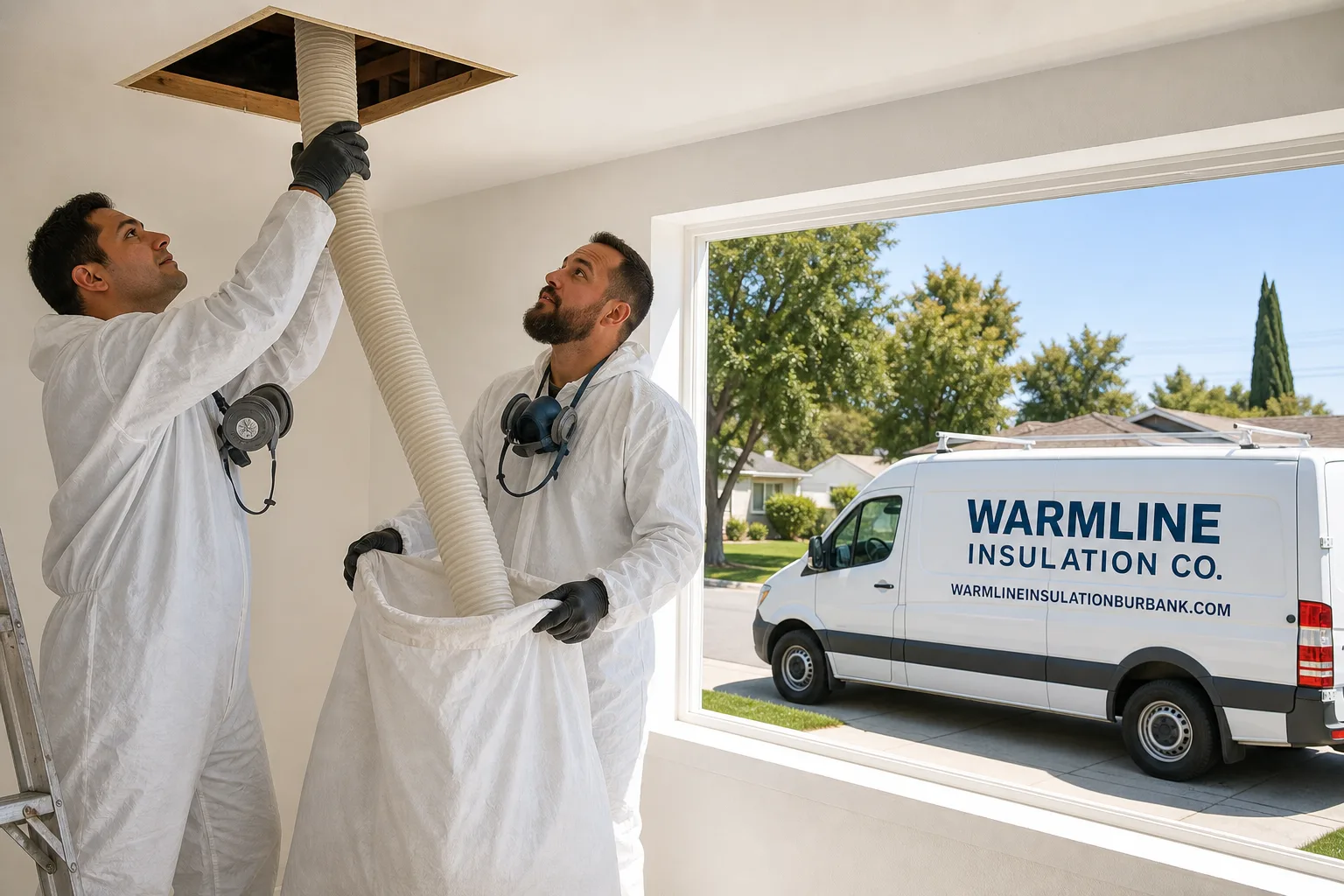
How Much Does Insulation Removal & Replacement Cost in Burbank?
Our Insulation Removal & Replacement services in Burbank, CA typically cost between $1,400 and $4,800 for a standard single-family home, depending on attic size, insulation type, and whether contamination from rodents or moisture is involved. Most Burbank homeowners with a 1,200-1,800 sq ft attic pay in the $1,800-$3,200 range for a full removal and blown-in replacement. That price includes debris hauling, basic air sealing, and new insulation to current California Title 24 standards.
If you want a firm number for your specific home, Warmline Insulation Co. offers free on-site estimates – a live person picks up at (747) 837-5834 any time you call.
Insulation Removal & Replacement Cost Breakdown (2026)
Here is how the costs typically break down for Burbank homes in 2026. These are real market ranges, not national averages copied from a database.
| Service Component | Typical Cost Range | Notes |
|---|---|---|
| Attic insulation removal (per sq ft) | $1.00 - $2.25/sq ft | Higher end for heavily compacted or contaminated material |
| Debris bagging & disposal | $150 - $400 | Rodent-contaminated material requires sealed disposal bags and adds cost |
| Attic sanitizing / decontamination | $250 - $600 | Required when rodent droppings, urine, or mold are present |
| Air sealing (pre-installation) | $300 - $800 | Sealing bypasses before new insulation dramatically improves performance |
| Blown-in fiberglass or cellulose replacement | $0.85 - $1.60/sq ft | Owens Corning, GreenFiber, and Knauf are our standard materials |
| Spray foam replacement (rim joists / penetrations) | $400 - $1,200 | Icynene or Demilec closed-cell for targeted air sealing zones |
| Batt insulation replacement (walls or crawl space) | $1.20 - $2.50/sq ft | Rockwool or CertainTeed batts; wall access affects cost significantly |
| Crawl space removal & vapor barrier replacement | $1,200 - $3,500 | Burbank’s clay-heavy soil traps ground moisture; vapor barrier quality matters here |
| Full attic removal + replacement (1,000 sq ft attic) | $1,400 - $2,800 | Clean attic, no contamination, blown-in replacement |
| Full attic removal + replacement (1,500 sq ft attic) | $1,900 - $3,500 | Standard Burbank ranch-style home with moderate accessibility |
| Full attic removal + replacement (2,000+ sq ft attic) | $2,600 - $4,800 | Larger homes, low-pitch roofs, or contaminated insulation |
A note on what shifts these numbers in Burbank specifically: homes built before 1980 in neighborhoods like Magnolia Park, Rancho Equestrian, and parts of the Burbank hills often have original fiberglass batts that have been compressed under HVAC equipment for decades. That compaction means slower vacuum removal, which adds labor time. Homes closer to the Verdugo Mountains sometimes have attic access points that are tighter or angled due to older architectural styles, which also bumps removal labor upward. Conversely, newer construction in the Downtown Burbank corridor tends to have clean, accessible attics that come in at the lower end of these ranges.
If your attic shows evidence of rats or mice – common along the Burbank-Glendale border and in older neighborhoods near Glenoaks – plan for decontamination on top of standard removal costs. We see this scenario regularly, and skipping proper sanitizing before new insulation goes in is the single fastest way to end up with a mold or odor problem inside your living space within a year.
What Affects Insulation Removal & Replacement Pricing in Burbank
- Attic size and accessibility: Square footage is the biggest single cost driver. Beyond that, a tight attic with a 24-inch access hatch takes significantly more labor to vacuum and clean than an open, walk-in attic. Many Burbank bungalows from the 1940s and 1950s have low-clearance attics where a technician cannot stand upright, which slows every step of the job.
- Contamination level: Clean, dry insulation that has simply lost R-value over time is the least expensive scenario. Old insulation mixed with rodent droppings, urine, or nesting material requires full PPE protocols, sealed disposal, and sanitizing spray before any new material is installed. In the Burbank market, we estimate contamination adds $400-$900 to a typical attic job.
- Insulation type being removed: Loose-fill cellulose or fiberglass vacuums out more cleanly than old-style vermiculite or sprayed asbestos-containing material. Any home built before 1978 in Burbank should be tested for asbestos before removal begins – if asbestos is confirmed, abatement by a licensed abatement contractor is required before insulation work can proceed, and that cost is separate from the insulation scope.
- New insulation type and R-value required: California Title 24 currently requires R-38 in attics for climate zones covering the greater Los Angeles/Burbank area, though R-49 to R-60 is increasingly recommended given how hot Burbank summers get (routinely above 100°F in July and August). Higher R-values mean more material, which increases the replacement cost.
- Existing air sealing conditions: If we find unsealed top plates, penetrations around plumbing stacks, or gaps at recessed light fixtures – all extremely common in pre-1990 Burbank homes – we strongly recommend sealing them before new insulation goes in. This is additional scope, but skipping it means the new insulation underperforms from day one. Expect $300-$800 for this step depending on how many penetrations need attention.
- Job timing and permit requirements: Burbank’s building and safety department does not typically require a permit for insulation replacement alone, but if mechanical work (HVAC repositioning, ductwork) is happening at the same time, permits may apply. We handle the coordination, but it can affect scheduling. Jobs booked during peak summer weeks when demand is highest sometimes carry a slight premium for next-day availability.
Burbank-Specific Factors You Won’t Find on Generic Pricing Pages
Burbank sits in a basin surrounded by the Verdugo Mountains to the north and the Santa Monica Mountains range to the west. That geography creates a genuine heat-island effect in summer and traps cold air in winter in ways that are distinct from coastal Los Angeles. We regularly see homes in the Rancho and Magnolia Park areas that show surface temperatures at the ceiling of 130°F or higher on August afternoons – even with existing insulation present. When we do thermal imaging on these homes, the culprit is usually a combination of radiant heat through the roof deck and insulation that has settled to an effective R-15 or lower. That is a 2-to-3 air-conditioning scenario waiting to happen.
Burbank also has a significant stock of mid-century homes with original blown-in insulation that was installed before modern fire-retardant requirements. Some of it is cellulose that has absorbed decades of attic moisture and effectively turned into a damp, compacted mat with little insulating value. Our crews pull this material out regularly in the Toluca Lake and Magnolia Park neighborhoods. It’s not an emergency, but every summer it spends in your attic is costing you money on your Burbank Water and Power bill.
One more local note: Burbank Water and Power (BWP) offers energy efficiency rebates that can offset part of your insulation upgrade cost. The program details change annually, so we recommend confirming current rebate levels with BWP directly, but in past years homeowners have received $200-$500 back on qualifying attic insulation projects. We can help you understand what documentation you’ll need when we do your estimate.
For a full picture of what we do from start to finish, visit our Insulation Removal & Replacement in Burbank service page.
How to Save on Insulation Removal & Replacement
There are real ways to reduce what you pay without cutting corners on the result. Here is what actually works in the Burbank market.
Bundle Removal with Air Sealing
The single highest-return move is pairing removal with attic air sealing in the same visit. You’re already paying for the crew to be in the attic – adding air sealing while the space is clear costs far less than scheduling it as a separate job, and the performance improvement is substantial. In Burbank homes built before 1990, we commonly find 10-20 unsealed penetrations per attic. Closing those before new insulation goes in can reduce cooling loads by 15-25%.
Get the Timing Right
Spring is our most requested season for removal and replacement in Burbank – homeowners notice drafts in winter, then book jobs before summer heat arrives. That demand surge means March through May books up fast. If your situation is not urgent, late fall (October-November) often has better scheduling availability and occasionally more pricing flexibility.
Use Our Standing Discounts
We have three standing offers that never expire. $50 Off Any Repair Over $250 applies to most removal and replacement jobs. If you’re a senior or a veteran, you get a permanent 5% discount on every job, every time – no coupons, no asking. And our $89 Seasonal Tune-Up is a good way to assess the current state of your insulation before committing to a full removal.
Look Into Utility Rebates
As mentioned above, Burbank Water and Power periodically offers rebates for insulation upgrades. Southern California Gas also has programs for homes with gas heating. These rebates don’t pay for the whole job, but $200-$500 back on a $2,500 project is meaningful. Ask us about current programs when you call.
Don’t Wait Until There’s a Problem
Degraded insulation that is left in place accumulates moisture, which creates conditions for mold. Insulation that rodents have already entered becomes a recurring rodent-access problem. A straightforward removal and replacement at $2,000 today often prevents a remediation job at $5,000-$8,000 two years from now. The math usually points toward acting sooner.
Start with a Free Estimate
Our estimates are free, on-site, and come with a written breakdown by line item – no vague “attic package” quotes that hide what you’re actually paying for. Call (747) 837-5834 and a live person will answer to schedule your visit. Most estimates take 30-45 minutes, and most jobs are completed in a single visit once you’re ready to proceed.
Signs Your Burbank Home Needs Insulation Removal
Not every home needs a full tear-out. But there are clear indicators that replacement – not just topping off – is the right answer:
- Visible rodent droppings, nesting material, or urine staining in the attic. Adding new insulation on top of contaminated material is not acceptable and will not pass a real inspection.
- Water damage or mold visible on existing insulation. This is common in Burbank homes with older roof penetrations or improperly vented bathroom fans dumping moisture directly into the attic.
- Insulation depth well below the 10-12 inches required for R-38. If you can see or nearly see the joists from the attic access, the insulation has either settled or was never adequate to begin with.
- Persistent pest odors inside the home, especially in rooms directly below the attic. This almost always means the existing insulation has absorbed contaminants and needs to come out.
- Energy bills that are consistently high despite a functioning HVAC system. We see this pattern regularly in older parts of Burbank, and the attic is the first place to look.
- Asbestos-containing material confirmed by a lab test. Homes built before 1978 in Burbank should be tested before any disturbance – and if asbestos is found, removal must follow abatement, not standard insulation removal protocols.
If you’re not sure which category your home falls into, a Home Energy Audit is the right starting point. We carry that service in-house, so the same company doing your audit can do the removal and replacement – no hand-off to a stranger with a different set of assumptions about your home.
The Warmline Removal & Replacement Process
We’re transparent about what we actually do on a job, because the steps matter for understanding why the pricing is what it is.
Step 1: On-Site Assessment
Before anything is removed, Neil Ashford’s team photographs the existing attic conditions, checks for moisture, pest evidence, and current insulation depth, and identifies all the air-sealing opportunities. This is where the line-item estimate comes from – not a price list on a clipboard.
Step 2: Vacuum Removal
We use commercial-grade insulation vacuums that pull material directly into sealed bags outside the home. A good residential vacuum holds 150-200 lbs per bag, and most Burbank attic jobs require 6-12 bags. The process keeps dust and particulates out of your living space.
Step 3: Sanitizing (When Required)
If rodent contamination is present, we apply an EPA-registered sanitizing solution to all attic surfaces before new material goes in. This step is not optional when we see droppings or urine staining – skipping it means encapsulating the biological hazard under new insulation.
Step 4: Air Sealing
With the attic clear, we seal top plates, plumbing and electrical penetrations, recessed light fixtures, and any other bypasses with canned foam or caulk appropriate to the opening size. This step is invisible once insulation goes in but accounts for a large share of the thermal performance gain.
Step 5: New Insulation Installation
We install blown-in fiberglass (typically Owens Corning or Johns Manville), blown-in cellulose (GreenFiber or Knauf), or batt insulation (Rockwool or CertainTeed) depending on what the space requires. All material is installed to the depth required for the R-value specified in your estimate – we verify depth with calibrated rulers at multiple points before we leave.
Step 6: Final Walkthrough and Documentation
You get a written record of before and after conditions, the insulation type and R-value installed, and confirmation of what was sealed. This documentation matters if you’re filing for a BWP rebate or selling the home.
Every job is backed by our 90-Day Done Right Promise: if something isn’t right, we come back and make it right. That commitment is in writing, and it’s the reason we don’t cut corners on any of the steps above. You can learn more about everything we offer across our home page.
FAQs: Insulation Removal & Replacement Cost in Burbank
How much does full attic insulation removal cost in Burbank?
Full attic insulation removal in Burbank runs $800-$2,000 for the removal step alone, not including disposal or replacement. A 1,500 sq ft attic with clean (non-contaminated) insulation comes in around $1,000-$1,400 for removal and hauling. Add $400-$900 if rodent contamination requires decontamination. Replacement insulation is priced separately based on type and R-value. Call (747) 837-5834 for a free, itemized estimate – we’ll give you a firm number before any work begins.
Is it cheaper to replace insulation or just add more on top?
Adding insulation on top is cheaper upfront – typically $0.85-$1.50/sq ft versus $1.85-$3.75/sq ft for a full removal and replacement. But topping off is only appropriate when the existing insulation is dry, uncontaminated, and still structurally intact. If it’s been compressed, wet, or exposed to pests, adding on top traps the problem and usually means doing the full removal within a few years anyway – at higher total cost. For most Burbank homes with original insulation that is more than 20 years old, replacement tends to be the smarter financial decision when you run the numbers over a 5-year window.
How long does insulation removal and replacement take in Burbank?
Most Burbank attic jobs – removal, air sealing, and replacement – are completed in one day. A 1,200-1,500 sq ft attic takes a crew of two roughly 4-7 hours from start to finish. Larger attics, low-clearance spaces, or jobs that include crawl space work may extend to a second day. We confirm the timeline during your estimate so you can plan accordingly, and we don’t leave a job partially done at the end of the day without a firm next-step commitment.
Does Burbank require a permit for insulation removal and replacement?
Burbank’s Building and Safety Division does not require a permit for standard residential insulation removal and replacement. If the scope includes changes to HVAC equipment, ductwork modifications, or structural work, permits may be triggered by those adjacent trades – but the insulation work itself is permit-exempt in most residential applications. We keep current with local code and will flag anything that might affect your specific job during the assessment. As a note, any property in Burbank with a confirmed asbestos-containing material requires abatement under AQMD Rule 1403 before insulation removal can begin – that process involves separate permits and a licensed abatement contractor.
What is the R-value required for attic insulation in Burbank?
California Title 24 requires R-38 minimum in attic assemblies for the climate zones covering Burbank. Given that Burbank regularly sees July and August temperatures above 100°F and that the city sits in a valley that retains daytime heat into the evening hours, we typically recommend R-49 to R-60 for homes where energy bills are a primary concern. The incremental material cost between R-38 and R-49 is modest relative to the year-round utility savings in this market. We’ll show you the payback math during the estimate.
Does Warmline Insulation Co. handle rodent-contaminated insulation removal?
Yes. Rodent-contaminated insulation removal is one of the more common scenarios we handle in Burbank, particularly in older neighborhoods near Glenoaks Boulevard and in homes along the foothills. The process requires full PPE, sealed bag disposal, and an EPA-registered sanitizing treatment before new insulation is installed. We also coordinate with pest control on rodent entry-point sealing – because removing contaminated insulation without sealing entry points just means the problem returns. Expect this full scope to add $400-$900 to a standard attic job, depending on the extent of contamination.
Key Takeaways
- Insulation removal and replacement in Burbank costs $1,400-$4,800 for most single-family homes, with the average landing around $2,000-$3,000.
- Removal alone runs $1.00-$2.25/sq ft; blown-in replacement adds $0.85-$1.60/sq ft.
- Contamination (rodents, moisture, mold) adds $400-$900 to the typical job – and skipping proper decontamination causes bigger problems down the road.
- California requires R-38 minimum; R-49 to R-60 is the practical recommendation for Burbank’s hot-summer climate.
- Burbank Water and Power rebates can offset $200-$500 of your project cost – ask us about current programs.
- Most jobs are completed in a single day by a two-person crew.
- All work is backed by Warmline’s 90-Day Done Right Promise.
- Senior and veteran homeowners receive a permanent 5% discount on every job.
Get a Free Estimate for Insulation Removal & Replacement in Burbank
If your home is losing heat in winter, absorbing it in summer, or dealing with the aftermath of a pest problem in the attic, the fix starts with a clear picture of what’s actually there. Warmline Insulation Co. has been working in Burbank homes since 2011, and Neil Ashford’s team has seen the full range of what California’s oldest housing stock throws at an attic. We give you a line-item estimate with no vague package pricing, show up in uniform and on time, and back everything with the 90-Day Done Right Promise.
Call (747) 837-5834 to schedule your free on-site estimate – a live person answers every call, any time of day. Most estimates take under an hour, and most jobs are scheduled and completed in a single visit.
Pricing reflects the Burbank market as of 2026. Warmline Insulation Co. offers free estimates – call (747) 837-5834.
Written by Neil Ashford, Owner at Warmline Insulation Co., serving Burbank, CA since 2011.
What Our Customers Say
"Crawl space smelled musty and the floors were cold. Full encapsulation with the thick liner taped at every seam, and a dehumidifier sized for the space. The hygrometer they left reads 48 percent now instead of the 70s."
- Elena Vasquez"Radiant barrier stapled to the rafters plus new baffles at the soffits. Attic temperature dropped enough that the AC runs noticeably less in the afternoon. Crew was in and out in a day and left the garage cleaner than they found it."
- Sam Kessler"They did the energy audit first - blower door and thermal camera - and showed me exactly where the house was leaking before selling me anything. The fix ended up being air sealing plus a modest attic top-up, not the full replacement another company pushed."
- Grace Nakamura